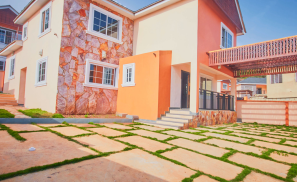
The decision to buy or rent a home is one of the most significant financial crossroads many African adults face. With rapid urbanization, increasing housing demands, and diverse financial realities across the continent, this choice is more than just a financial decision—it reflects cultural, societal, and economic factors unique to the African context. While renting offers flexibility and is often more accessible in the short term, owning a home carries cultural significance in many African societies. Homeownership is frequently associated with stability, prestige, and intergenerational wealth. However, the financial complexities and high costs involved in purchasing a home make it challenging for many to take this step.
Renting vs. Buying: The Financial Perspective
In African cities, renting remains a popular choice due to lower upfront costs and minimal long-term commitments. Tenants typically pay monthly rent and, in some cases, a security deposit. On the other hand, homeownership involves more intricate financial planning, including securing a mortgage (often with high interest rates in many African countries), paying for land acquisition, and handling construction or maintenance costs.
To assist prospective homeowners, tools like rent-to-buy calculators are invaluable. These tools consider the most important costs associated with buying a home—mortgage payments, property taxes, maintenance, and insurance—and compute the equivalent monthly rent. By using such tools, Africans can make informed decisions based on their financial circumstances and market conditions.
Reclaiming Homeownership After Financial Challenges
The housing market in Africa is also seeing shifts as individuals impacted by economic challenges begin to recover. For example, in countries like Ghana, Kenya, and South Africa, middle-income earners who were previously excluded from the mortgage market due to financial instability are gradually regaining their purchasing power.A new study by TransUnion suggests that more than 1.5 million potential homeowners globally—many of whom reside in emerging markets like Africa—could re-enter the mortgage market within the next three years. This shift represents a significant opportunity for real estate developers and financial institutions to create more inclusive housing solutions tailored to the continent's growing population.
Addressing Housing Challenges in African Cities
The housing sector in Africa is grappling with unique challenges, including limited access to affordable financing, high land prices, and inadequate infrastructure. These factors make homeownership difficult for many and contribute to the growing demand for rental properties. However, innovative approaches, such as government-backed mortgage schemes, public-private partnerships, and flexible payment plans, are beginning to bridge the gap. Renting, while practical for many, may not provide the same level of security or long-term benefits as homeownership. As African cities continue to grow, housing solutions must evolve to meet the needs of diverse populations, from young professionals looking for affordable rentals to families seeking long-term stability through ownership.
A Growing Market of Opportunity
For millions of Africans, the decision to rent or buy a home is not just a financial one—it reflects aspirations, cultural values, and a vision for the future. With tools like rent-to-buy calculators, prospective homeowners can better understand the costs involved and plan effectively. As the continent’s housing markets mature, addressing affordability and accessibility will be key to unlocking opportunities for millions.
Africa’s housing narrative is one of transformation, resilience, and growth. By empowering individuals to make informed decisions, governments, developers, and financial institutions can play a crucial role in shaping a future where housing is not just a necessity but a foundation for prosperity and progress.
Written by
JL Properties